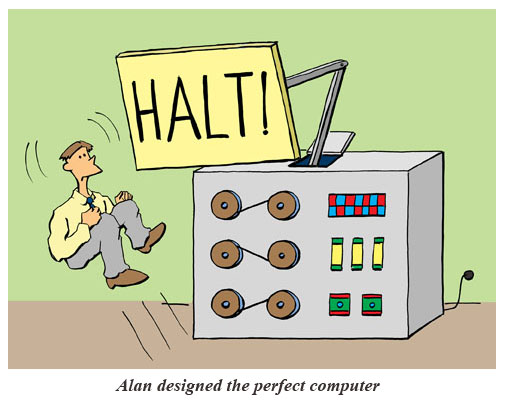
Last quarter, I took a class called CS103: Mathematical Foundations of Computing. The TAs sent us a wonderful little poem about the Halting Problem that was pretty clever and funny. It helps to clarify what can be quite a difficult concept for many students to wrap their heads around.
I realize this won’t make sense for anyone who’s not a computer science person, so if that’s you then please enjoy this hamster eating a carrot.
Ok, if you’re still here, then enjoy:
SCOOPING THE LOOP SNOOPER
A proof that the Halting Problem is undecidable
Geoffrey K. Pullum
(School of Philosophy, Psychology and Language Sciences, University of Edinburgh)
No general procedure for bug checks succeeds.
Now, I won’t just assert that, I’ll show where it leads:
I will prove that although you might work till you drop,
you cannot tell if computation will stop.
For imagine we have a procedure called P
that for specified input permits you to see
whether specified source code, with all of its faults,
defines a routine that eventually halts.
You feed in your program, with suitable data,
and P gets to work, and a little while later
(in finite compute time) correctly infers
whether infinite looping behavior occurs.
If there will be no looping, then P prints out ‘Good.’
That means work on this input will halt, as it should.
But if it detects an unstoppable loop,
then P reports ‘Bad!’ — which means you’re in the soup.
Well, the truth is that P cannot possibly be,
because if you wrote it and gave it to me,
I could use it to set up a logical bind
that would shatter your reason and scramble your mind.
Here’s the trick that I’ll use – and it’s simple to do.
I’ll define a procedure, which I will call Q,
that will use P’s predictions of halting success
to stir up a terrible logical mess.
For a specified program, say A, one supplies,
the first step of this program called Q I devise
is to find out from P what’s the right thing to say
of the looping behavior of A run on A.
If P’s answer is ‘Bad!’, Q will suddenly stop.
But otherwise, Q will go back to the top,
and start off again, looping endlessly back,
till the universe dies and turns frozen and black.
And this program called Q wouldn’t stay on the shelf;
I would ask it to forecast its run on itself.
When it reads its own source code, just what will it do?
What’s the looping behavior of Q run on Q?
If P warns of infinite loops, Q will quit;
yet P is supposed to speak truly of it!
And if Q’s going to quit, then P should say ‘Good’
— which makes Q start to loop! (P denied that it would.)
No matter how P might perform, Q will scoop it:
Q uses P’s output to make P look stupid.
Whatever P says, it cannot predict Q:
P is right when it’s wrong, and is false when it’s true!
I’ve created a paradox, neat as can be —
and simply by using your putative P.
When you posited P you stepped into a snare;
Your assumption has led you right into my lair.
So where can this argument possibly go?
I don’t have to tell you; I’m sure you must know.
By reductio, there cannot possibly be
a procedure that acts like the mythical P.
You can never find general mechanical means
for predicting the acts of computing machines.
It’s something that cannot be done. So we users
must find our own bugs. Our computers are losers!
(If you liked this, you might like Freedom of Speech on the Internet.)