None of Us Knows What We’re Doing

May 22nd, 2011 | 40,333 views | 87 Comments » |

I’ve noticed a disturbing trend among a few of the young programmers, designers, and entrepreneurs who I know at Stanford. I’ve learned that many of them share the same mistaken belief about success and how it works.

The Myth of the Superhuman

They believe, it seems, that “successful people” like Steve Jobs, Mark Zuckerberg, Bill Gates, Paul Graham, Walt Disney, etc. have some sort of in-built superhuman awesomeness that makes them smarter, cleverer, more brilliant than the rest of us.

They believe that something about these people is unique, that their feats would be unachievable by anyone else.

To be fair, it sort of makes sense, right? I mean, these folks succeeded spectacularly where thousands of others failed forgettably. So, the successful people must be more brilliant than average folk like you and me, no?

An Anecdote: YouTube Instant

Something about this line of thinking doesn’t sit right with me. I know from my own experience building YouTube Instant that success oftentimes just happens without any foresight, pre-planning, or exceptional skill.

When I built YouTube Instant, I was certain that someone else had built something like this before. Sure, I thought it was a neat idea, but it didn’t seem that special to me.

I certainly had no idea that writing those 190 lines of JavaScript would change my life forever.

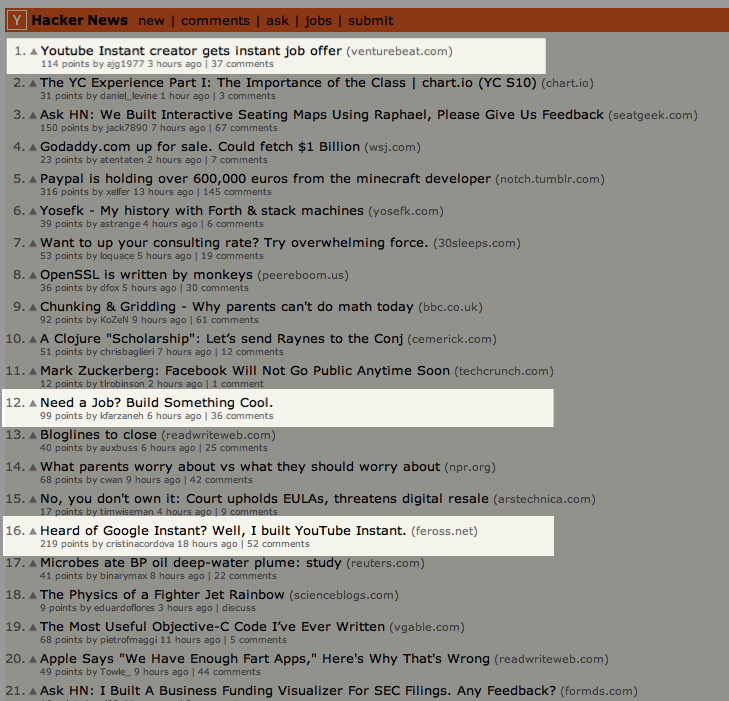
I never could have predicted that such a simple hack would go on to get 1 million visitors in 10 days, garner worldwide media attention, and earn me a personal job offer from Chad Hurley (who was YouTube CEO at the time; now the owner of Delicious). How could I possibly have predicted all that?

The truth is, I nearly watched a movie with my roommate instead of building YouTube Instant that night (the movie we were considering was Grave of the Fireflies if you’re curious). Needless to say: I’m so happy that I decided to code instead of watch a movie that night.

(Note: I am not comparing YouTube Instant to Apple, Facebook, or Microsoft. Building my little tech demo was nowhere near as awesome as starting a company. Yet, I still think that there are interesting lessons to learn from YouTube Instant that apply equally to the founders of Apple, Facebook, and the rest.)

So, what lessons does this teach us?

Lesson #1. None of us knows what we’re doing.

I wasn’t being especially brilliant when I thought of YouTube Instant. I didn’t have an epiphany, a secret how-to guide, or any awareness about the viral potential of the site. It was simply a random idea, like any other.

Here is the truth. None of us knows what we’re doing. We are all just winging it. Yep, that’s right. Even Fortune 500 CEOs, Nobel Prize winners, and U.S. presidents — all are really good at winging it.

The sooner you realize that no one knows what they’re doing, the sooner you’ll lose your fear of uncertainty and just go for it. Successful people aren’t by necessity any smarter than the rest of us.

Lesson #2. Don’t listen to successful entrepreneurs.

The folks who succeed have no way to know if their success was due to talent, skill, and planning, or merely dumb luck.

If you ask them though, they’ll confidently spout reason after reason why they — and no one else – could possibly own 90% of the desktop PC market, or whatever they achieved. In their minds, it couldn’t have turned out any other way. Most of this is just after-the-fact rationalization, though. The truth is, they succeeded and have no idea why. They’re just explaining it in the best way they can.

(I also think that some successful entrepreneurs are self-conscious about their success. They are afraid that people might think their success was only luck. So they start company after company trying to replicate their first success. On the other hand, most entrepreneurs just love building stuff — it’s in their blood. It’s hard to tell the two apart.)

Lesson #3. You can’t predict what will succeed.

With YouTube Instant, almost everything was luck. I was lucky to hear about Google Instant right when it came out. I was lucky to have the idea for YouTube Instant pop into my head — it was completely random. I was lucky to have 3 free hours that day to build the site (yep, I built the whole thing in 3 hours). I was lucky that someone I’d never met before decided to share the link on Hacker News. I was lucky that Chad Hurley was reading Hacker News when the link was on the homepage. And so on…

The only thing that was in my control, however, was whether or not I decided to show up.

Ninety percent of life is just showing up. — Woody Allen

I decided to build YouTube Instant instead of watching a movie. That decision was the only thing 100% in my control. I decided to turn off the incessant trivial chatter on Twitter and TechCrunch, get my hands dirty, and just build something.

Several Hacker News commenters lamented the fact that they didn’t build this first. Others derided the idea as obvious and trivial, and therefore not worth building. (post 1, post 2)

This comment captures my thoughts on the matter perfectly:

[YouTube Instant is] using existing mechanisms in YouTube’s JSON API to find suggestions and play them. All the true “magic” is provided by YouTube’s engineers. Not to take it away from someone who writes the right lines of JavaScript at the right time, but you don’t have to place the guy on a pedestal.

The real lesson here is for yourself and others here who think like you — if you tell yourself that things like this take superhuman efforts, how will you ever be able to produce something creative yourself?

Exactly.

Lesson #4. You can create your own luck.

Building stuff that people use — even stuff that goes viral — doesn’t take superhuman effort. It just takes a willingness to get your hands dirty (as discussed above) – something that most hackers and entrepreneurs already possess.

If you keep building stuff, you create your own luck. That’s how you learn and get better. But, first you have to believe that it’s possible.

Best thing to do: always believe that extraordinarily epic wins are possible. Conversely, don’t worry if you fail — just move on to the next thing.

Recently, a researcher studied the lives of 400 people over the course of 10 years and watched for any lucky breaks or chance encounters — both good and bad. Here is what he found:

My research revealed that lucky people generate good fortune via four basic principles. They are skilled at creating and noticing chance opportunities, make lucky decisions by listening to their intuition, create self-fulfilling prophesies via positive expectations, and adopt a resilient attitude that transforms bad luck into good.

Lesson #5. Don’t compare yourself to others.

Look at the code for YouTube Instant. It’s butt ugly. I was pretty awful at JavaScript 9 months ago.

If I had compared myself to Brendan EichJohn Resig, Paul IrishAlex Sexton, or other JavaScript badasses I would have just got depressed and never built anything. Better to write ugly code with a bunch of hacks than to write nothing at all.

When I interned at Facebook last summer, I heard from other engineers that early Facebook code quality was pretty awful. I also heard that Mark Zuckerberg wasn’t exactly the best programmer in the world (not sure how accurate this is, but I heard it from a few people).

The point is: he did the important things right. Zuck had great product vision and he didn’t fret about writing perfect code.

Done is better than perfect.

Bonus: Lesson #6. Stop reading Hacker News.

Hacker News is awesome — don’t get me wrong. It’s a great way to follow the goings-on of the hacker community. But, like everything else in life, it’s subject to the law of diminishing returns.

Easy question. Which is better: 3 more hours reading Hacker News? Or, 3 hours spent building YouTube Instant?

Neo, sooner or later you’re going to realize just as I did that there’s a difference between knowing the path and walking the path. — Morpheus, “The Matrix”

Thank you for reading. Happy hacking.

You should share this with your friends:

87 Comments | Leave a comment » More posts about: Hacks, Startups, Web Dev

87 Comments on “None of Us Knows What We’re Doing”

  1. 1 Scott Barlow said at 3:08 am on May 22nd, 2011:

    Blog post “Would you admit that you don’t know what you’re doing?” http://strwbrry.com/?p=306 – great post Feross

  2. 2 Rahul Pai said at 3:09 am on May 22nd, 2011:

    Awesome post Feross … its reflects your humility

  3. 3 Feross Aboukhadijeh said at 3:13 am on May 22nd, 2011:

    Scott, Rahul: thank you both for your comments.

    Glad you liked the post. I usually don’t write in this style, but I think I’m going to start doing it more.

  4. 4 Ochuko said at 3:28 am on May 22nd, 2011:

    This is the truth. We can’t connect the dots looking forward. We just need to have faith that it’ll somehow connect in the future. That’s what Steve Jobs’ said.
    Cool post.

  5. 5 Abdulmumen Naas said at 3:33 am on May 22nd, 2011:

    What a great article. I completely agree with you.
    Although I was one of those guys who always think that things must be perfect to be done. I always searched for “best practice”, and the result was, I haven’t done anything. When I first learned programming I was looking for how to do big things. Later, I found myself in a mess and forgot how actually programming works. Because I left simple things behind, I was afraid to do things wrong. Finally I realised that “done is better than perfect”.

    Great article Feross Keep it up.
    mumen

  6. 6 Javier Guillen said at 1:14 pm on May 22nd, 2011:

    Great article. I completely agree with you! I share this at my facebook and twitter! Congrats!

  7. 7 Ryan Hoover said at 1:20 pm on May 22nd, 2011:

    Great honest post, Feross.

    In regards to #3, You Can’t Predict What Will Succeed, that certainly doesn’t mean you should pursue just any idea that comes up. Gut instinct/experience and often times more importantly, data, should curate your projects.

    Of course, side projects just for fun don’t necessarily apply. :)

  8. 8 Steven said at 3:46 pm on May 22nd, 2011:

    I can’t agree with some of the points listed here.

    #1 – You have some cognitive level of what you’re doing, what you’re aiming for. While it is impossible to know everything or a lot of where you’re going, having some basic foundation of knowledge is important.

    #2 – I can agree to an extent that some people can’t predict how large their company may or may not become but to find success and scale a successful company, to a varying degree, some people do have the answers and to argue that everyone doesn’t know what they’re doing is just blatantly ignorant.

    #3 – Depends on the market, product, service, etc. You can predict to an extent. Not everything is base on luck. You seem to take your Youtube Instant success story a bit too extreme (and it’s definitely getting to your head). I’m not going to rag on your for always promoting it everywhere you can and RT-ing every article that comes your way but keep your ego in check.

    #4/#5 – Agreed

    #6 – Agreed to the extent that its better to spend your time on more productive things but it’s also good to have some downtime and HN is better than TV or other downtime activities (personal preference here of course).

  9. 9 The Daily Flailing « Mike Cane's xBlog said at 3:51 pm on May 22nd, 2011:

    [...] None of Us Knows What We’re Doing Here is the truth. None of us knows what we’re doing. We are all just winging it. Yep, that’s right. Even Fortune 500 CEOs, Nobel Prize winners, and U.S. presidents — all are really good at winging it. [...]

  10. 10 Rahul Shivkumar said at 4:54 pm on May 22nd, 2011:

    Great article man , really inspired me.

  11. 11 Mihaela MJ said at 5:35 pm on May 22nd, 2011:

    I love the line:
    “Done is better than perfect.”
    I do have to remind myself of that, though :)

  12. 12 Terry A. Davis said at 6:15 pm on May 22nd, 2011:

    God decides who succeeds and fails.

  13. 13 Saurabh Shah said at 6:32 pm on May 22nd, 2011:

    Nice post. You seem very down to earth! I do believe in building a lot of doors and letting the opportunity knock! I also count where opportunity knocks the most and destroy rest of the useless doors :)

  14. 14 krist said at 7:41 pm on May 22nd, 2011:

    couldn’t agree more. adds some more evidence to the so-called black swan phenomenon .

  15. 15 Umesh Agrawal said at 9:26 pm on May 22nd, 2011:

    This is real! I agree, we do a lot of things that we dont know and that is where we get courage from. once we start getting into the depth more before we do anything then it starts getting late. I always feel that there is opportunity in every crisis! just see the spark and follow it!

  16. 16 Josh Valdez said at 9:45 pm on May 22nd, 2011:

    … and instantly Feross looses 200 Twitter followers and blog subscribers who are determined to build things and stop reading blog posts. Lol.

    Jokes aside, great post! Very encouraging and humble.

  17. 17 Faisal Memon said at 9:54 pm on May 22nd, 2011:

    Cool…..I agree with this !!!!

  18. 18 Jason said at 9:59 pm on May 22nd, 2011:

    @Terry A. Davis
    Which god?

  19. 19 Sabyasachi Ghosh said at 10:00 pm on May 22nd, 2011:

    Awesome post Feross, really inspired me.

  20. 20 Peter Wang said at 10:05 pm on May 22nd, 2011:

    You spend 3 hours building a mashup site that gets a lot of viral attention – congrats! Good work! But that somehow qualifies you to declare that no one else knows what they’re doing? Steve Jobs, Warren Buffet, Bill Gates, etc. are all just winging it?

    That’s quite a stretch.

  21. 21 Ken said at 10:33 pm on May 22nd, 2011:

    you may not realize it but #6 translates across a lot. Maybe people think watching movies, listening to DVD commentary, etc helps in being a wannabe filmmaker. Many follow their competitors on various industry rags because they think it helps. But are those activities better than just getting to work? That’s the real question.

    Thanks for reminding me I’m wasting my time reading what you wrote. Honest. Most bloggers FYI don’t say that.

  22. 22 Manne Laukkanen said at 11:21 pm on May 22nd, 2011:

    Thank you so much for this concise post. After getting a PhD in psychology to find out what makes people special I ended up with exactly the thoughts you have there. Motivation, determination, desire, industriousness…sometimes even a little faith in one’s future helps. Talent is overrated. Chance and factors outside one’s control are underrated. Just do it!

  23. 23 Chris West said at 12:02 am on May 23rd, 2011:

    Great post! I strongly believe in the after-the-fact-rationalisation phenomenon too. I don’t think anyone can plan where they end up, but it’s a predictable response to try to find reasons other than luck to suggest why I made a million, and you didn’t.

  24. 24 Jacques said at 12:53 am on May 23rd, 2011:

    Money quote : “Done is better than perfect.”.

  25. 25 Lucas said at 1:11 am on May 23rd, 2011:

    Great Read! Love the matrix quote hah :D

  26. 26 taige said at 2:17 am on May 23rd, 2011:

    found your post on yc – will start following you :) nice article.

  27. 27 Kenbellars said at 3:42 am on May 23rd, 2011:

    Yes.. your article is pure and awesome i must confess.

    While the title is kinda hyperbolic, I agree with you we have little control or awareness of “what is to come.” Your idea is more like the principle of participation.

  28. 28 Alex said at 4:47 am on May 23rd, 2011:

    Sloppy, tendentious thinking. I don’t see how you get from having written a popular piece of JavaScript to the conclusion, “Don’t listen to successful entrepreneurs.” Maybe creating a company is harder than writing some JavaScript, and entrepreneurial success is based on skill, not luck? You note that Mark Zuckerberg “had great product vision” – an idea that would seem to contradict your entire point, that success is mostly based on luck, and that anyone who tells you otherwise is just committing “after-the-fact rationalization”.

  29. 29 steve said at 5:40 am on May 23rd, 2011:

    Nice article, thank you. Especially like the bit about stop reading hacker news so much, so true. Rather then actually deving something can spend hours reading about other peoples dev.

  30. 30 Rajeev N Bharshetty said at 8:08 am on May 23rd, 2011:

    Awesome Post … Motivated me a lot

    And the things you talked about are 100% right :)

  31. 31 fak3r said at 8:35 am on May 23rd, 2011:

    great post, and it illustrates much of what I’ve learned during my IT ‘career’.

  32. 32 links for 2011-05-23 | inluminent said at 9:03 am on May 23rd, 2011:

    [...] None of Us Knows What We’re Doing (tags: startup mark_zuckerberg hacks fortune_500 via:zite) [...]

  33. 33 Patrick said at 11:03 am on May 23rd, 2011:

    Feross,

    Lovely thoughts. I’m just starting to learn how to write in code languages myself (starting with Python, which is a weird place to start…). But, even if a strong conceit, your statements do resonate as mostly true.

    Also, if you haven’t yet, do be sure to find time to sit down and watch Grave of the Fireflies. :)

  34. 34 Nigel C'rasto said at 1:49 pm on May 23rd, 2011:

    Feross Aboukhadijeh…this was your best blogpost ever…

    now i wanna get my hands dirty!

  35. 35 Seth Brundle said at 7:50 pm on May 23rd, 2011:

    Having been in the business for 16 years, I can tell you that this is absolutely not true.

    Luck happens, hard work and genius also happen. They are not mutually exclusive.

    I’ve had weeklong projects that popped up and returned millions for my company on CNBC, thats dumb luck.

    18-month software projects of my own which insured 8 years of self-employment and returned over $2M in personal income.

    That was not dumb luck.

    And as for showing up, I would say that the projects that sounds cool that you *do not* waste your time on are even more important than the ones you choose.

  36. 36 The Birth Of An Idea « Napoleon Suarez said at 11:06 pm on May 23rd, 2011:

    [...] and I was pretty good. I was also a pretty smart dude. Not smart in the way sense that I could code an internet sensation in three hours, but smart in a way where I can get things done, but still look kinda cool when it was all done. [...]

  37. 37 Rory O'Connor said at 11:38 pm on May 23rd, 2011:

    I really enjoyed your article. I would also agree with you – you aren’t born lucky, but can do a lot to increase the chances of being lucky by getting on and making ‘stuff’.

    I’m also glad that you’re happy you created YouTube Instant. I’ll bet you would have been in tears if you’d watched Grave of Fireflies! A real tear-jerker.

  38. 38 Wascally Wabbit said at 9:25 am on May 24th, 2011:

    If ignorance is a virtue, what about ineptitude? Or sloth? Isn’t it better to wait until fortune finds you snoozing under a tree somewhere?

  39. 39 Paul Travis CMC said at 3:31 am on May 25th, 2011:

    Speaking as employee 1000 at Microsoft, I once bumped into employee 5000 or so and postulated: “We were in the right place at the right time — we didn’t create the tremendous value increase the stock market reflected.” He was incensed and insisted he’d earned it all. I say, we really didn’t know what we were doing :)

  40. 40 Do you really know what you’re doing as an entrepreneur? - Rebelic /by Timan Rebel (@timanrebel) said at 11:52 pm on May 25th, 2011:

    [...] couple of days later I read a post from Feross Aboukhadijeh, creator of YouTube Instant among other things, claiming none of us really knows what we are doing [...]

  41. 41 這一切都是瞎貓碰上死耗子,真的! » Mr. Jamie 看網路與創投 said at 3:45 pm on May 26th, 2011:

    [...] Stanford 資工系學生 Feross Aboukhadijeh (佛羅斯‧阿布卡迪傑) 的這篇「None of Us Knows What We’re Doing」,也是在講同一件事情,他說: [...]

  42. 42 Rohan said at 6:35 pm on May 26th, 2011:

    wow.
    This is just an amazing post. Thanks, you helped a high schooler interested in CS out

  43. 43 Rohit said at 10:28 am on May 27th, 2011:

    Feross, great article!
    Thanks for the inspiration.
    Lesson I am taking from here – ‘Perfect is better than done, but done is better than none’

  44. 44 没有人知道我们正在做什么 » 36氪 said at 5:17 am on May 28th, 2011:

    [...] None of Us Knows What We’re Doing [...]

  45. 45 無心插柳柳成蔭 | How To Win said at 2:41 pm on May 28th, 2011:

    [...] Stanford 資工系學生 Feross Aboukhadijeh (佛羅斯‧阿布卡迪傑) 的這篇「None of Us Knows What We’re Doing」,也是在講同一件事情,他說: [...]

  46. 46 Martin said at 4:16 am on May 29th, 2011:

    Great post! I agree, often it is just a little bit of luck that makes us successful. However, I disagree with your point that entrepreneurs do not know why they are successful. From my experience tech entrepreneurs (not necessarily internet / software) reflect a lot about failure as well as success. The best entrepreneurs are the ones that failed and learned a lot from their mistakes.

  47. 47 没有人知道我们程序员正在做什么 | 点滴网 said at 4:57 am on May 29th, 2011:

    [...] 英文原文:None of Us Knows What We’re Doing [...]

  48. 48 Nihit said at 5:28 am on May 29th, 2011:

    Reading every word in there was worth the time ! Nice post. I’m a CS undergrad too .. currently studying Indian Institute of Technology-Madras. (I’m from India).

    Cheers !

  49. 49 Anita said at 1:35 am on May 30th, 2011:

    “Better done than perfect” – This is ABSOLUTELY TRUE.We programmers can’t document so well but we do code pretty UGLY. ;-)
    My colleagues always ask me to add the comment and write the code BEAUTIFULLY but I never follow because I still believe it is better to see if the application is running well rather than having a beautiful coding where the appln is not running.

    Cheers!

  50. 50 A Weekly Round-Up of Small-Business News - NYTimes.com said at 3:03 am on May 31st, 2011:

    [...] BEYOND HIS YEARS Feross Aboukhadijeh, a Stanford student, says  none of us knows what we’re doing. Example: “Don’t listen to successful entrepreneurs. The folks who succeed have no way to know [...]

  51. 51 You’re the Boss: This Week in Small Business: Oprah, Banks and Credit Cards said at 4:36 am on May 31st, 2011:

    [...] BEYOND HIS YEARS Feross Aboukhadijeh, a Stanford student, says  none of us knows what we’re doing. Example: “Don’t listen to successful entrepreneurs. The folks who succeed have no way to know [...]

  52. 52 This Week in Small Business: Oprah, Banks and Credit Cards | Gov Grants said at 12:44 pm on May 31st, 2011:

    [...] BEYOND HIS YEARS Feross Aboukhadijeh, a Stanford student, says  none of us knows what we’re doing. Example: “Don’t listen to successful entrepreneurs. The folks who succeed have no way to know [...]

  53. 53 My Latest Interest « Napoleon Suarez said at 8:35 pm on June 6th, 2011:

    [...] None of Us Know What We’re Doing (REALLY smart Stanford kid) I say all that to say that I am really intrigued when someone takes a leap of faith with dreams of becoming something extraordinary. It really reminds me of the passion that I once had to be a musician. Dropping everything to do what I loved has always been a passion of mine. Not saying that I would leave SEER anytime soon, but I do think I will start diving back into my passion project and spending some time working on a healtyh work/life balance. I may share my idea soon [...]

  54. 54 Daniel Alabi said at 10:38 pm on June 8th, 2011:

    Great post! You’ve really inspired me. My hacktivation energy is now lower and my thirst for creativity I feel is greater. Thanks for reaching out and not keeping your experiencs to yourself.

  55. 55 Sanjay Bhatia said at 4:22 pm on June 9th, 2011:

    Very interesting article, and I completely agree btw.

    Highly recommend “The Black Swan” (Nicholas Taleb). Much more detailed along these same lines.

  56. 56 没有人知道我们正在做什么 said at 10:01 am on June 10th, 2011:

    [...] via:None of Us Knows What We’re Doing [...]

  57. 57 Lessons From The Creator Of YouTube Instant said at 8:43 pm on June 13th, 2011:

    [...] you waste another day, stop what you’re doing, and read Feross’ post here: None Of Us Knows What We’re Doing. Then commit to showing up and just do something…anything. Try. Sure you’ll fail, but [...]

  58. 58 Mohnish Thallavajhula said at 12:59 pm on June 15th, 2011:

    Best of your blogs dude. Simply awesome. Inspired I should say :)

  59. 59 Julian Baldwin said at 11:29 pm on June 15th, 2011:

    Great post Feross. Thanks for putting into words such great insight as to how we entrepreneurs might consider to approach the journey.

    Did you by chance ever read Outliers by Gladwell?

    In the book, he talks about the context in which Gates (an obvious outlier) grew up. A lot of his success had less to do with his intelligence, and more to do with the resources he had access to that other intelligent programmers his age did not.

    When he was in high school, his mother knew someone who would grant him access to a cluster of computers on a college campus. This early exposure, combined with heaps of curiosity and persistence, all contributed to his success.

    What is nice is how Gates says much of his success can be attributed to him growing up inside the right environmental conditions. Most of which, was not at all in his control earlier in life.

    Julian

  60. 60 A Little Something For Everyone, 10 Posts I Read And Commented On This Week said at 11:36 am on June 19th, 2011:

    [...] None of Us Knows What We’re Doing [...]

  61. 61 Sam Kidd said at 4:06 am on July 4th, 2011:

    A really great blog post, although I really should be doing something instead of just reading this :-p

  62. 62 Seb said at 6:10 am on July 6th, 2011:

    A great post and one that I needed to read today. I am just trying my hand at websites etc. A few months ago I could only get email and Google. Very motivational for people from all walks of life.

  63. 63 Cliff said at 7:24 pm on July 7th, 2011:

    Thanks Feross. All of these insights definitely ring true, especially #6. For all those who struggle with hackernews, have you ever tried https://github.com/leftnode/get-shit-done? Completely enhanced my productivity. I admit the name of the script is a tad vulgar, but it’s priceless. (I renamed my copy to get-stuff-done, a little more family friendly.)

  64. 64 Feross Aboukhadijeh said at 8:52 pm on July 7th, 2011:

    Hey Cliff, thanks for sharing a link to Get Shit Done. I’ll check it out.

    Thanks for commenting!

  65. 65 Waynesmillion said at 11:25 am on July 12th, 2011:

    What a great post. I too had an idea, found out it was done before, but tried it anyways. It has since peaked, but not because of the idea itself, rather my attitude. Time to wing it again, and if I fail, no one will remember, or care… if I succeed, everyone knows! :D

  66. 66 clement sadjere said at 2:12 am on July 18th, 2011:

    I agree with most commentators about the awesomeness of the post.Unless one tries an idea, life may seem so boring.The entrepreneurial journey seems easy with tips like this.

  67. 67 Harsh Warikoo said at 12:26 am on August 7th, 2011:

    All our progress is an unfolding, like a vegetable bud. You have first an instinct, then an opinion, then a knowledge as the plant has root, bud, and fruit. Trust the instinct to the end, though you can render no reason.-ralph waldo emerson

  68. 68 J Kumarswamy said at 9:31 pm on August 16th, 2011:

    H! what a lucky person you are Feross
    I am impressed i would like to congratulate to you.Then started my career in right way.

  69. 69 Quora said at 1:58 pm on September 3rd, 2011:

    How did Feross Aboukhadijeh learn to program?…

    TL;DR: I learned how to program by building lots of websites. And now, the full story: I’ve been asked this question a lot lately, especially after I built YouTube Instant. I learned how to program by working on lots of different website projects star…

  70. 70 Origin Stories: James Li- Compass Partners said at 11:17 am on September 7th, 2011:

    [...] you’re ever in the need for some motivation, watch The Social Network and read this blog post. Really gets the blood going, [...]

  71. 71 How I Learned to Program Computers » Feross.org said at 5:26 pm on September 13th, 2011:

    [...] that YouTube Instant’s success was mostly due to chance good timing and a little luck. Read None of Us Knows What We’re Doing for some more of my thoughts about [...]

  72. 72 Simon said at 8:16 am on September 16th, 2011:

    Love the post, inspiring stuff. I needed to read something like this today. Currently stumbling my way through my first project and its great to have advice like this.

  73. 73 Sangam said at 12:45 pm on September 20th, 2011:

    Great stuff, Feross. You’re quite right about the law of diminishing returns. Ideas tend to float around us, hence the importance of actually executing them rather than just watch them pass by.

  74. 74 Vivek Narayanan said at 5:12 am on September 30th, 2011:

    Great observation, Feross, thanks for firing me up again. Very inspirational stuff.

  75. 75 Rajesh Namase said at 1:42 pm on October 12th, 2011:

    Very good post, thanks for sharing such nice thoughts.

  76. 76 How I Learned to Program Computers said at 8:44 pm on October 16th, 2011:

    [...] know that YouTube Instant’s success was mostly due to chance good timing and a little luck. Read None of Us Knows What We’re Doing for some more of my thoughts about [...]

  77. 77 Origin Stories: James Li | The Compass Blog said at 5:42 pm on October 29th, 2011:

    [...] you’re ever in the need for some motivation, watch The Social Network and read this blog post. Really gets the blood going, [...]

  78. 78 None of Us Knows What We're Doing said at 8:13 am on December 12th, 2011:

    [...] is a smart guy. He wrote this about doing the best we can at the time, because we have no idea how it will all end up. If you start something (a project, a class, a [...]

  79. 79 An Annual Roundup of Small-Business News - NYTimes.com said at 4:02 am on December 27th, 2011:

    [...] do it. How do you explain success? Feross Aboukhadijeh, a student at Stanford University, says that none of us really knows what we’re doing. “Don’t listen to successful entrepreneurs. The folks who succeed have no way to know if their [...]

  80. 80 You’re the Boss Blog: An Annual Roundup of Small-Business News | | BUSINESS VOCABULARYBUSINESS VOCABULARY said at 6:14 am on December 27th, 2011:

    [...] do it. How do we explain success? Feross Aboukhadijeh, a tyro during Stanford University, says that none of us unequivocally knows what we’re doing. “Don’t listen to successful entrepreneurs. The folks who attain have no approach to know if [...]

  81. 81 You’re the Boss Blog: An Annual Roundup of Small-Business News said at 9:20 am on December 27th, 2011:

    [...] do it. How do you explain success? Feross Aboukhadijeh, a student at Stanford University, says that none of us really knows what we’re doing. “Don’t listen to successful entrepreneurs. The folks who succeed have no way to know if their [...]

  82. 82 This Year in Small Business: The Best Reads said at 7:48 pm on December 27th, 2011:

    [...] do it. How do you explain success? Feross Aboukhadijeh, a student at Stanford University, says that none of us really knows what we’re doing. “Don’t listen to successful entrepreneurs. The folks who succeed have no way to know if their [...]

  83. 83 This Year in Small Business: The Best Reads | Financial IQ said at 8:05 pm on December 27th, 2011:

    [...] do it. How do you explain success? Feross Aboukhadijeh, a student at Stanford University, says that none of us really knows what we’re doing. “Don’t listen to successful entrepreneurs. The folks who succeed have no way to know if their [...]

  84. 84 This Year in Small Business: The Best Reads | Leomoo.com said at 11:38 pm on December 27th, 2011:

    [...] do it. How do you explain success? Feross Aboukhadijeh, a student at Stanford University, says that none of us really knows what we’re doing. “Don’t listen to successful entrepreneurs. The folks who succeed have no way to know if their [...]

  85. 85 This Year in Small Business: The Best Reads | Money How said at 9:35 am on December 28th, 2011:

    [...] do it. How do you explain success? Feross Aboukhadijeh, a student at Stanford University, says that none of us really knows what we’re doing. “Don’t listen to successful entrepreneurs. The folks who succeed have no way to know if their [...]

  86. 86 This Year in Small Business: The Best Reads | iGlobal Market Services said at 2:27 am on December 31st, 2011:

    [...] do it. How do you explain success? Feross Aboukhadijeh, a student at Stanford University, says that none of us really knows what we’re doing. “Don’t listen to successful entrepreneurs. The folks who succeed have no way to know if their [...]

  87. 87 Happy New Year! First post of 2012- “None of Us Knows What We’re Doing” | Hoboken Hoodlum said at 5:28 am on January 1st, 2012:

    [...] http://www.feross.org/none-of-us-knows-what-were-doing/ [...]


Leave a Reply

Fork me on GitHub